Share this
by Josefine Fouarge on Mar 31, 2026, 8:30:00 AM
A client calls with a failed server.
You or your tech spend two hours troubleshooting, diagnosing the backup failure, reconfiguring the job, running a test restore, documenting the fix.
Two hours of genuine expertise but none of it appears on the invoice.
That's the reseller trap in miniature. You're already providing monitoring, configuration, and incident response. You're simply not charging for any of it. The client pays for a license, and you absorb everything else.
The first blog post in this series covered why the market shifted. Ransomware made backup a board-level concern, executives now ask for proof of recovery, and a green checkmark stopped being enough. If you haven’t read it, it’s worth a few minutes. This post takes the next step and talks about what that shift means for your business model, and why the margin numbers make a compelling case for changing it.
Table of Contents
- The IT-Reseller Trap
- Reseller Margins vs. Managed Service Margins
- Why Clients Pay More for Managed Backup
- Choosing Backup Software Built for MSPs
- Frequently Asked Questions
- Making the Switch to Managed Backup
The IT-Reseller Trap
Reselling backup is like being a parking attendant for someone else's garage. You handle the complaints, you do the work, but you don't own anything. And you're competing on price with every other attendant who has internet access.
Clients call you when things break. That's true whether you control the product or not, and your margin was never built to cover it.
The structural problems compound over time:
- Margins on product resale are thin, typically a 15–30% discount off MSRP, and only higher with significant volume commitments. Unbilled support time makes those margins thinner still. There's no path to growth on that foundation.
- You can't differentiate when your competitors sell the exact same license at the same price (or when your client can go buy it directly).
- By buying “just a license”, it’s much easier for your customer to switch to a different software or service provider.
The invisible labor problem is the one that stings most. MSPs routinely spend hours per month per client on work that genuinely protects that client's business, and write it off as the cost of doing business. While the managed model doesn't change the work, it at least charges for it.

Reseller Margins vs. Managed Service Margins
Here's what reselling and managing backup actually look like side by side.
Revenue figures are illustrative. Actual pricing varies by your client size, data volume, and service tier.
Canalys chief analyst Jay McBain noted in 2024 that roughly 30% of MSPs with managed contracts “don’t make money consistently”. For the average eight-person MSP, driving EBITDA above 15–17% is genuinely difficult given overhead (Canalys/MSP Success, 2024). Managed backup, priced as a service rather than a product pass-through, is one of the cleaner paths out of that constraint.
Twenty managed backup clients at $100/month is $24K in annual recurring revenue at 60%+ margin. The same twenty clients on a reseller model at $30/month is $7.2K, with thin margins and unbilled support time eating into it further.
Real-world example: Michael Gustine of MG Technology, a one-man IT shop, transitioned to NovaBACKUP Managed Backup and is projecting 17–25% customer base growth by year's end, without adding staff. "I'm looking to build a monthly residual income stream," he said. "Once it's set up, I can envision it needing very little maintenance on my part."
There's also a retention dynamic here that the margin numbers alone don't capture. A managed backup client is genuinely hard to move. Their backup history, configurations, retention policies, and restore records all live in your environment. Switching to a new provider means migrating data, re-onboarding, and losing that history. meaning real friction that license customers never face. When you manage the outcome rather than supply a component, you become part of how their business runs. That relationship deepens over time in a way that a license renewal never does.
Why Clients Pay More for Managed Backup
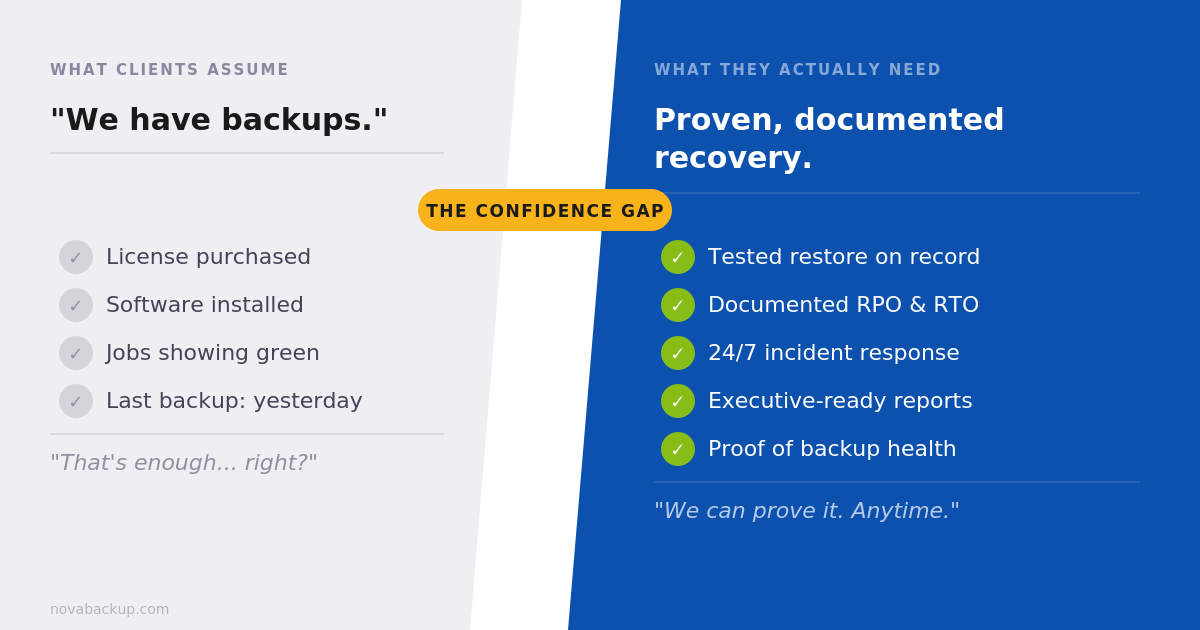
The economics above assume you’re pricing a managed service against a license. There’s a second lever too: what clients are now willing to pay, and why. Customers want the certainty that their business will survive a disaster. Backup software and a storage bucket are just the means. That distinction matters, because it changes the conversation about what you're selling and with that, what you can charge.
SMBs with 1–200 employees face average downtime costs of $100,000 per hour (ITIC, 2024). Nearly 1 in 5 SMBs that suffered a cyberattack filed for bankruptcy or closed entirely (Mastercard Small Business Cybersecurity Study, 2025). Put next to a $100K/hour downtime cost, $100/server/month looks like what it is: cheap insurance.
The shift matters because it changes who you’re talking to and what they care about. Executives don’t evaluate backup on storage price per GB. They evaluate it based on you being able to demonstrate a successful restore, what the recovery timeline is, and what happens when something fails at 2am. MSPs who can answer those questions with documentation and tested results win deals that price-focused resellers can’t even compete for.
A managed backup relationship also functions as a foot in the door for other services, such as Disaster Recovery planning, cyber insurance documentation, compliance work, and so on. Clients who trust you with backup are already primed to ask about these services, which price very differently than a license.
One more note: higher prices won't hurt you with the clients worth having. Business owners who take data protection seriously are not shopping for the cheapest option. And a price that looks like a budget offering signals exactly the wrong thing to them. The clients most likely to stay, refer others, and grow with you are the ones who chose you for what you deliver.

Choosing Backup Software Built for MSPs
One practical reason many resellers might not have made this shift is that the tools they have were designed for a different model. Backup software built for enterprise IT or consumer use forces MSP workflows into structures that don’t fit, including separate logins per client, manual report exports, billing processes that require three tools to produce one invoice.
A platform built for managed backup works differently. NovaBACKUP’s multi-tenant architecture keeps each client’s data and settings fully isolated while you manage them all from one console. It gives you complete visibility across your client base, with built-in reporting that generates the client-facing proof of backup health executives now demand. See the full feature overview on the NovaBACKUP Managed Backup product page.
Frequently Asked Questions
FAQ
Why am I losing money reselling backup licenses?
Your margin on license resale is typically 15–30%, and it doesn't cover the monitoring, configuration, and support work you're already doing for free. The client pays for a license and you absorb everything else. That labor never appears on an invoice.
FAQ
How much more does managed backup pay compared to reselling?
Twenty clients at $100/month managed is $24K in annual recurring revenue at 60%+ margin. The same twenty clients at $30/month on a reseller model is $7.2K, with margins already thin and unbilled support hours eating into them further.
FAQ
Why would a client pay more for managed backup than a license?
Because the conversation shifts from software cost to business risk. A $100/server/month service looks entirely different next to a $100,000/hour downtime cost. Executives aren't buying storage, they're buying a documented answer to the question of what happens when systems fail.
FAQ
Will managed backup clients actually stick around longer?
Their backup history, configurations, retention policies, and restore records all live in your environment. Moving to a new provider means migrating that data, re-onboarding, and losing the history. That friction is real and it doesn't exist for clients who just bought a license.
FAQ
Do I have to migrate all my clients at once to switch models?
No. You can run both models at the same time and move clients over gradually. Start with one or two, build a repeatable process, and expand when you're confident in it. No client has to notice a transition is happening.
Making the Switch to Managed Backup
Clients are asking harder questions, executives are involved in backup decisions, and “we have backups” stopped being a sufficient answer. The MSPs who move to managed backup now will own the trust narrative in their markets. Those who wait will compete on price forever.
You can start small. One or two clients, a proven process, then expand at your own pace. The transition doesn't have to be disruptive. You can run both models in parallel, migrating existing clients gradually while you build confidence in the new one. No client needs to feel a thing.
The next post in this series gets concrete on what managed backup actually looks like in practice. We'll cover how to define your service, set Recovery Point Objectives (RPO) and Recovery Time Objectives (RTO), and build service tiers that clients will pay for.
Start a free NovaBACKUP trial and see the managed backup model in practice.
Explore the MSP management console firsthand, or book a call with a NovaBACKUP backup expert to walk through how the managed backup solution works for your client base.
About This Series
This post is part of The MSP Managed Backup Playbook, a five-part series for MSPs building or growing a managed backup service.
Post 1: The MSP Backup Business Is Changing
Post 2: The Business Case for Managed Backup (this post)
Post 3: What Managed Backup Actually Looks Like in Practice
Post 4: Building and Running Your Managed Backup Service
Post 5: Pricing, Positioning, and Winning New Customers
Sources
- Canalys / McBain, Jay (2024). Cited in: MSP Success, 'The Profitability Crisis in the Managed Services Industry,' November 2024. — Approximately 30% of MSPs with managed contracts don't make money consistently; average MSP EBITDA above 15–17% is difficult to achieve at typical scale.
- ITIC (2024). 2024 Hourly Cost of Downtime Survey. — SMBs with 1–200 employees: average $100,000/hour downtime cost.
- Mastercard (2025). Small Business Cybersecurity Study — Nearly 1 in 5 SMBs that suffered a cyberattack filed for bankruptcy or closed.
Worth Reading
5 Backup Security Checks MSPs Should Run Before Attackers Do
Multi-Location Clients Need a Different Backup Plan Than Single-Site Ones | Data Protection Digest | September 2026
Share this